
Excavator Grapple Bucket vs. Box Grapple vs. Bucket & Thumb: Which One Is Actually Right for Your Application?
July 6th, 2026
7 min. read
By Mike Noward
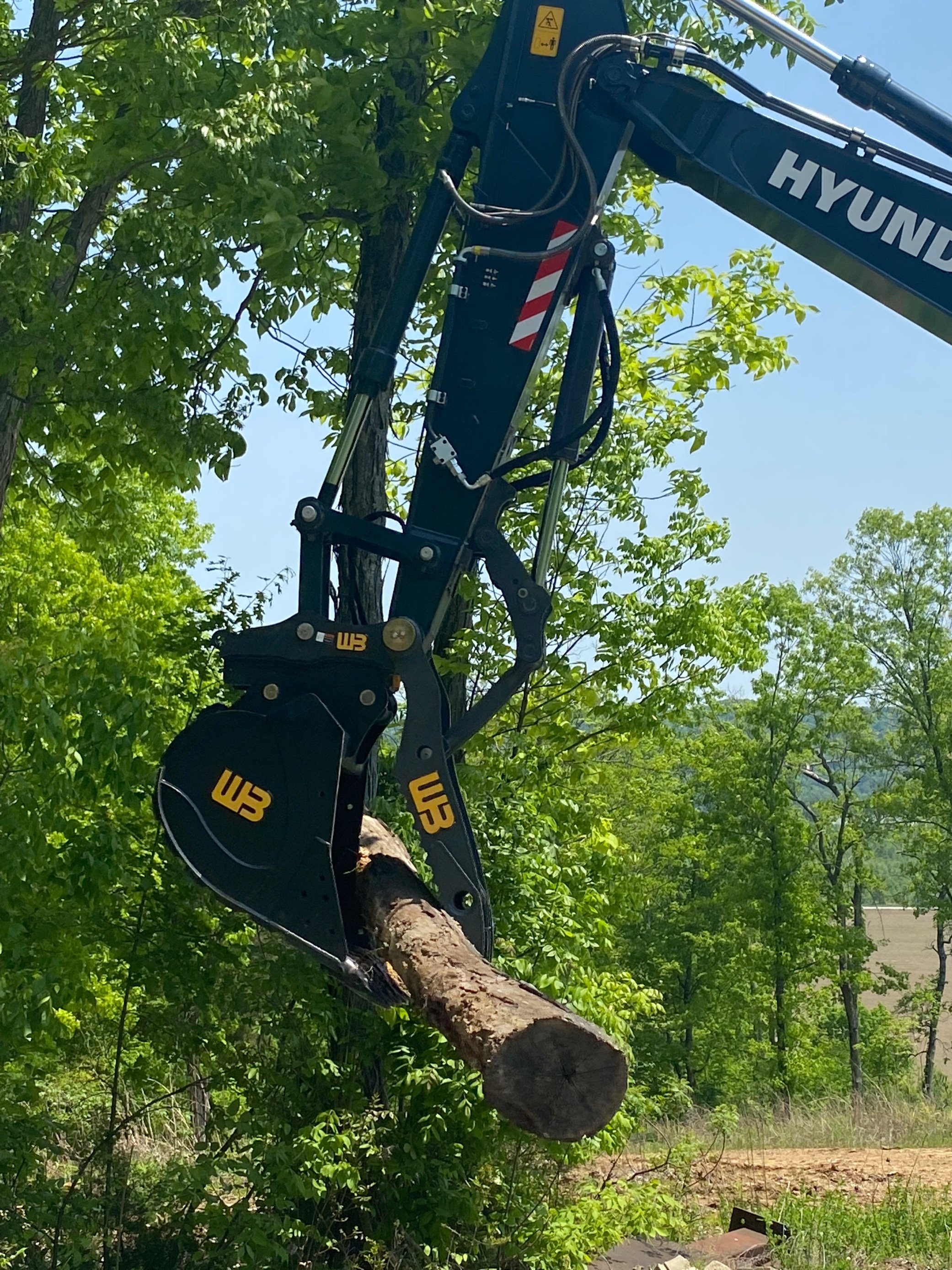
In my ten years in the industry one thing has become clear for me. Application is everything. There is nuance in every discussion, and no solution is really perfect. There’s always some give and take with any attachment. With land clearing and demolition that holds true. Selecting the right excavator attachment is a common decision point for contractors, fleet managers, and dealer representatives. The choice between a grapple bucket, box grapple, or bucket-and-thumb configuration depends heavily on the machine’s primary application and the type of material being handled.
When the wrong attachment is selected, the impact extends beyond the initial purchase price. Inefficient attachment selection can reduce productivity, slow cycle times, and create unnecessary operational costs throughout the life of the attachment.
In this guide I am attempting to help break down the options by application. We’ll cover land clearing, demolition, and general excavation, and we’ll tell you exactly what each tool does well, where it falls short, and what questions a buyer should be asking before they commit.
What’s the Difference Between an Excavator Grapple Bucket, Box Grapple, and Bucket with Thumb?
Before we compare, everyone needs to be working from the same definitions, because these terms get misused constantly in the field and at the dealer counter.
A grapple bucket or our version the WB HydraGrip - also called a clamshell grapple or combination bucket - is a standard bucket profile with hydraulic tines mounted on the top. It can curl and close like a bucket, but also grip, clamp, and carry loose or irregular material. You get digging capacity and grappling capability in one attachment. You may have heard of industry brands like Werk-Brau HydraGrip®, Rockland Krypto Klaw®, TAG Mantis®, AMI Graptor®
A box grapple, sometimes called an open-top grapple or skeleton grapple, is a frame-style attachment with opposing tine sets that open wide and clamp shut. There’s no solid bucket. It’s built purely for grabbing, sorting, and moving large volumes of bulky material. Think recycling/processing centers, brush, stumps, scrap, loading rail cars, and debris piles.
A bucket & progressive link thumb is a standard digging bucket, cleanup bucket or grading bucket; paired with a hydraulic thumb mounted to the stick. The progressive link geometry keeps the thumb tips tracking consistently with the bucket’s curl angle throughout the full range of motion, maintaining a secure grip at any position.
These are three distinct tools solving three overlapping but meaningfully different problems.
Still not sure? Watch this video before buying your thumb: https://youtu.be/CubZkXv-eb4
Bulk Loading: Why a Box Grapple Is Usually the Best Choice
If your crew operates a recycling center, scrap yard or clears timber, brush, root balls, debris piles, the box grapple is the purpose-built answer. Here’s why.
Bulk loading of material at recycling centers and scrap yards are truly the primary application. Land clearing can also generate enormous volumes of bulky, irregular, low-density material. Trees, limbs, brush, and stumps don’t stack neatly and require being loaded out. Typically used in conjunction with other machines where you need an attachment that can open wide, engulf a large chaotic pile, clamp down, and carry it efficiently to a burn pile or chipper. A box grapple’s open tine design lets debris compress and interlock during the grab, which means fewer cycles to move the same volume compared to a grapple bucket with a closed pan that limits opening width. Theres also the benefit when loading material into a grinder. No teeth or pins to risk getting caught in the grinder and costing exorbitant amounts of money to fix when it happens.
The trade-off: a box grapple can’t dig. If your clearing job also requires grubbing stumps below grade, shaping a swale, or loading topsoil into trucks, you’ll be reaching for a different tool mid-job or running two attachments.
For large fleet operators: If you have dedicated clearing crews running fleets on timber and brush contracts, a box grapple is almost always the highest-ROI attachment for that specific task. The productivity-per-hour advantage over a grapple bucket on pure clearing work is significant enough to justify the single-application limitation. This attachment can free up other machines that need to work in variable applications or underground.
For dealer reps: When a customer is pricing out a land clearing attachment, the right question is “Does this machine also need to dig on this job, or is it clearing and loading only?” That single answer usually determines whether they need a box grapple or a grapple bucket.
Demolition: When a Grapple Bucket Makes the Most Sense
Demolition work is where the grapple bucket starts to pull ahead of the other two options - and where the bucket-and-thumb combination starts to show its limits.
Demo sites are dynamic. One hour you’re ripping out a concrete foundation. The next you’re sorting rebar from rubble or loading chunks of block into a haul truck. The grapple bucket gives you the ability to break material with the bucket’s digging edge, then immediately clamp and sort with the grapple tines - without an attachment change.
The closed bucket also matters here. When you’re grabbing irregular debris, concrete block, structural steel, mixed rubble, the solid floor of a grapple bucket gives you retention that a box grapple’s open tine frame can’t match on smaller, fragmented material. Chunks fall through a box grapple. They don’t fall through a grapple bucket. Some applications would benefit from a skeleton version of the bucket so that fine material falls through while still maintaining the larger content that you are trying to move or sort.
A bucket-and-thumb combination can absolutely work in demolition, and plenty of experienced operators will tell you a quality progressive link thumb is all they need. For precision work, pulling a wall, gripping a beam, peeling back a roof section, the thumb’s ability to pinch a specific object is arguably better than a grapple attachment. But for high-volume sorting and loading after the initial demolition, the thumb slows you down. Every load cycle requires deliberate grip engagement. A grapple bucket is faster in bulk-handling mode.
For large fleet operators: On demo-heavy fleets, the grapple bucket is the most versatile single attachment you can put on a machine. If your operators are moving from job to job where applications vary, demo one week, site cleanup the next, standardizing on a grapple bucket reduces your attachment inventory without sacrificing capability.
For dealer reps: In demolition conversations, lead with versatility. The customer who thinks they’re buying a demolition attachment is often also buying a cleanup attachment, a material-handling attachment, and sometimes a light digging attachment. The grapple bucket story sells itself when you frame it that way. This bucket is also great for rental fleets which allows you to have the capability of a thumb without having to install on so many of your machines.
General Excavation: This Is the Bucket-and-Thumb’s Domain
For straightforward digging, grading, trenching, pipe laying, and utility work, no grapple configuration out-performs a well-matched bucket paired with a progressive link thumb.
Here’s the core issue with grapple attachments in general excavation: the tine structure adds weight and restricts visibility, and neither the grapple bucket nor the box grapple is optimized for clean bucket fill. You lose digging efficiency, fill factor drops, you carry dead weight from the tines, and precision grading becomes harder. On jobs where you’re moving cubic yards of material, that inefficiency adds up fast over a shift.
A quality digging or grading bucket, sized correctly for the machine’s breakout force and the material, combined with a hydraulic progressive link thumb gives you something the grapple configurations can’t fully replicate. You can grip a single boulder, place a pipe with exact control, or sort specific debris from clean fill. The thumb makes the bucket system adaptive without sacrificing the digging efficiency you need for the primary task.
The progressive link design specifically matters here. A thumb that doesn’t maintain consistent tip geometry through the curl range creates dead zones where grip is weak or awkward. On a quality progressive link thumb, the geometry is engineered so the operator gets a predictable, strong pinch at any bucket position, which translates to operator’s confidence and faster cycle times.
For large fleet operators: If most of your machine hours are in utility, civil, or general site work with occasional material handling, a bucket-and-thumb setup is almost always the right answer. It protects your digging efficiency where you earn most of your productivity and gives you the flexibility to handle the exceptions without a second attachment.
For dealer reps: When a customer defaults to asking for a grapple because they’ve seen one on a competitor’s machine, ask them what their primary task cycle looks like. If 80% of their hours are in the dirt, not on top of it, a thumb conversation will often result in a better outcome for the customer and a stronger long-term relationship for you.
The Decision Framework: Three Questions to Get to the Right Answer
Whether you’re a fleet manager specifying 20 machines or a dealer rep configuring one, these three questions cut through the noise:
| What percentage of operating hours is the machine digging vs. handling material above grade? | Heavy digging = bucket and thumb. Heavy handling = grapple. Mixed = grapple bucket. |
| Is the primary material bulky and irregular, or dense and fragmented? | Bulky material includes brush, logs, and debris. Dense or fragmented material includes dirt, rock, rubble, and concrete. Bulky = box grapple. Dense/fragmented = grapple bucket or bucket and thumb. |
| How often will this machine change applications? | Single application = optimize for that task. Multi-application = grapple bucket or bucket and thumb win on versatility. |
A Note on Quick Couplers and Fleet Standardization
For large fleet operators, this conversation can’t happen without mentioning quick couplers. The ability to switch between a grapple bucket, a digging bucket with thumb, and a box grapple in under a minute changes the calculus entirely. Instead of compromising on a single attachment, you spec the right tool for each task and train your operators to change out efficiently.
If your fleet is running manual couplers, or worse, pin-on, you’re adding friction to every attachment decision. That friction pushes operators toward “good enough” compromises that cost productivity over hundreds of machine hours. It’s worth running the numbers on what coupler standardization would do for your fleet before you finalize any attachment purchase.
The Bottom Line
There is no universally correct answer between these three configurations, but there is a correct answer for your application. A box grapple on a land-clearing crew is a productivity machine. That same box grapple on a utility excavator is a liability. Getting this decision right means starting with the application, not the attachment catalog.
If you’re a dealer rep reading this: the operators and fleet managers who trust you most are the ones you’ve helped make the right call, even when the right call was a lower-margin option. That’s the conversation that earns the next ten machines.
If you’re a fleet owner or equipment manager: the right attachment for your specific application mix is worth a detailed conversation, not a catalog page. The difference between the right tool and the almost-right tool shows up every day on your cycle times.
Werk-Brau has manufactured excavator attachments in Findlay, Ohio since 1947. Our engineering team works directly with contractors and dealers to match the right attachment to the right application. Contact your Werk-Brau dealer or reach out to our sales team to talk through your specific fleet needs.
Mike is the Marketing Manager at Werk‑Brau and brings years of experience from the field as a Regional Sales Manager. He focuses on connecting product expertise, customer insight, and practical messaging to help customers make confident equipment decisions.
