
A lot of the questions we get surround the capacities of buckets. How big of a capacity can I get? What is the difference between struck and heaped capacity? Understanding excavator bucket capacities is key for estimating productivity, planning operations, and selecting the right equipment for the job. Here’s a clear breakdown of the main concepts:
- What Is Bucket Capacity?
Bucket capacity is the volume of material an excavator bucket can hold, usually measured in:
- Cubic yards (yd³) or cubic feet (ft³) in the U.S.
- Cubic meters (m³) elsewhere
There are two ways that we measure capacities:
- Struck Capacity: The volume of material the bucket can hold when level with the top of the bucket. (Conservative estimate). Think of it like measuring flour for a baking recipe.
- Heaped Capacity: The volume of material including a heap above the bucket’s edge, following a specific “heap angle” | typically 1:1 slope. (More realistic, used in productivity calculations). Think of the most material you can get in a bucket.
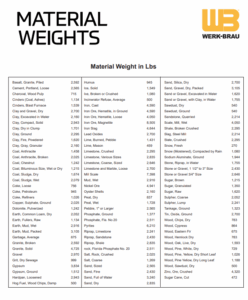
For a more detailed breakdown of capacities by material, please reference our Bucket Selector Chart.
- How Bucket Capacity Is Calculated
The formula for a basic bucket shape is an approximate estimation:
But in practice, capacity is often found in manufacturer specs, because buckets aren’t perfect boxes—they’re curved.
Capacity = Width x Height x Depth x Fill Factor
Fill Factor: Accounts for material packing and shape. Typical values:
- Loose soil: 100–110%
- Clay: 90–100%
- Rock: 80–95%
- Matching Bucket Size to Excavator
How to match the right bucket size to your excavator:
Typically, the first question that we get is, “What is the widest bucket or largest capacity that I can put on my machine?” However, it is our opinion that we need to look at the bucket capacity in terms of the application and balance the capacity to the overall weight and efficiency of the machine. Other factors come into play such as, if the machine has a coupler on it, what material you are digging in, what size truck you are loading, operator skill, and stick configuration of your machine. Bigger is not always better. This is where partnering with a quality manufacturer that will help guide you in your decision is important. Werk-Brau likes to get involved early with both the dealer and the end user to come up with the best solution.
| Machine Weight | Typical Width | Typical Weight | Typical Capacity |
| 2,150-4,900 lbs | 8-36” | 75-260 lbs | 0.78 CF – 4.60 CF |
| 5,000-7,000 lbs | 10-36” | 150-315 lbs | 1.78 CF – 6.64 CF |
| 7,500-11,000 lbs | 12-36” | 250-475 lbs | 3.00 CF – 10.00 CF |
| 11,000 -14,000 lbs | 12-42” | 370-720 lbs | 3.50 CF – 15.50 CF |
| 14,000 – 16000 lbs | 12-42” | 400-780 lbs | 5.00 CF - 16.90 CF |
| 16,000 – 25,000 lbs | 16-42” | 605-810 lbs | 7.00 CF - 20.10 CF |
| 24,000 – 32,500 lbs | 18-48” | 850-1725 lbs | 0.36 CY – 1.25 CY |
| 33,000 – 41,500 lbs | 18-48” | 950-2,200 lbs | 0.42 CY – 1.41 CY |
| 42,000 – 50,000 lbs | 24-54” | 1500-2,875 lbs | 0.65 CY – 1.96 CY |
| 50,500 – 59,000 lbs | 24-60” | 1,825 – 3,125 lbs | 0.79 CY – 2.40 CY |
| 59,500-68,000 lbs | 24-66” | 1,875 – 4,075 lbs | 0.86 CY – 2.88 CY |
| 68,500 – 82,000 lbs | 24-72” | 2,250 – 4,900 lbs | 0.93 CY – 3.69 CY |
| 82,500-105,000 lbs | 24-72” | 2,600 – 6,345 lbs | 1.09 CY – 5.82 CY |
| 105,000 – 125,000 lbs | 30-84” | 4,315 – 7,980 lbs | 1.75 CY – 6.40 CY |
| 125,500 + | Check with WB |
Please see our article, "How to Choose the Right Excavator Bucket" for a more detailed explanation of which bucket is right for you.
- How Does the Material I Am Digging in Impact Capacity?
Different materials weigh and behave differently:
The material that you are primarily digging in will greatly affect your ability to retain material in your bucket. For example, dry sand is going to flow easily and exit the bucket which will not allow you to retain as much material as something like clay, which will hold together.
| Material | Loose Density (lbs/yd³) | Notes |
| Sand (dry) | ~2,700 | Flows easily, high density |
| Clay (wet) | ~3,000 | Sticky, may not fill bucket fully |
| Gravel | ~3,000 | Heavy, requires strong machine |
| Rock | 3,000–4,000+ | Often uses smaller buckets to protect the machine |
- Practical Tips
- Don’t oversize buckets: It can stress the boom and reduce machine life.
- Use narrow buckets for trenching, wide buckets for grading.
- Use high-capacity buckets for light materials (e.g., mulch, topsoil), and rock buckets for demolition or quarry use.
- Bucket teeth, side cutters, and wear plates can increase your total capacity or your ability to retain material
At the end of the day, choosing the right excavator bucket capacity isn’t just about matching numbers on a spec sheet, it’s about maximizing your productivity, protecting your equipment investment, and ensuring every job runs smoothly from start to finish. While the calculations and considerations we’ve covered will point you in the right direction, every operation is unique. Your specific soil conditions, job requirements, machine specifications, and productivity goals all play a role in determining the optimal bucket capacity for your needs.
As the manufacturer behind thousands of excavator buckets working in the field today, Werk-Brau has helped operators and contractors across every industry solve their bucket capacity challenges. Our engineering team will partner with you to specify the exact capacity and configuration that will deliver maximum performance for your specific applications.
No pushy sales tactics, just honest advice from the people who’ve been perfecting excavator bucket design for 78 years and counting.
Questions about capacity calculations or need help with a specific application? Call our sales team at 1 (800) 537-9561. We’re here to help, not just sell.
Topics:
