
Tree Shear or Feller Buncher: Which Forestry Attachment Is Right for Your Job?
August 24th, 2026
5 min. read
At a glance:
A tree shear is a versatile, cost-effective option for contractors handling land clearing, right-of-way work, storm cleanup, and smaller diameter trees, while a feller buncher is built for high-volume forestry and larger timber applications. The right choice comes down to your carrier, jobsite needs, production goals, and long-term value.
An age-old question, is bigger better? Not always, just ask Goliath. Sometimes the mightier warrior comes in a much smaller package. When determining what is right for your land clearing and forestry work, you need to understand the fundamental difference between tree shears and feller bunchers. The answer would be what and how much you are attempting to cut and or process. Tree Shears are best in the lighter areas, where as feller bunchers lend themselves to much larger projects involving trees of 2 foot in diameter or more. While both have clear cut advantages, the Grapple Shear is a much more cost-effective unit, coming in around $15-30K per unit where Feller Bunches can range from the low $30’s to upwards of $100K. This price point may make sense when looking at mass production life cycle cost.
How Does It Work
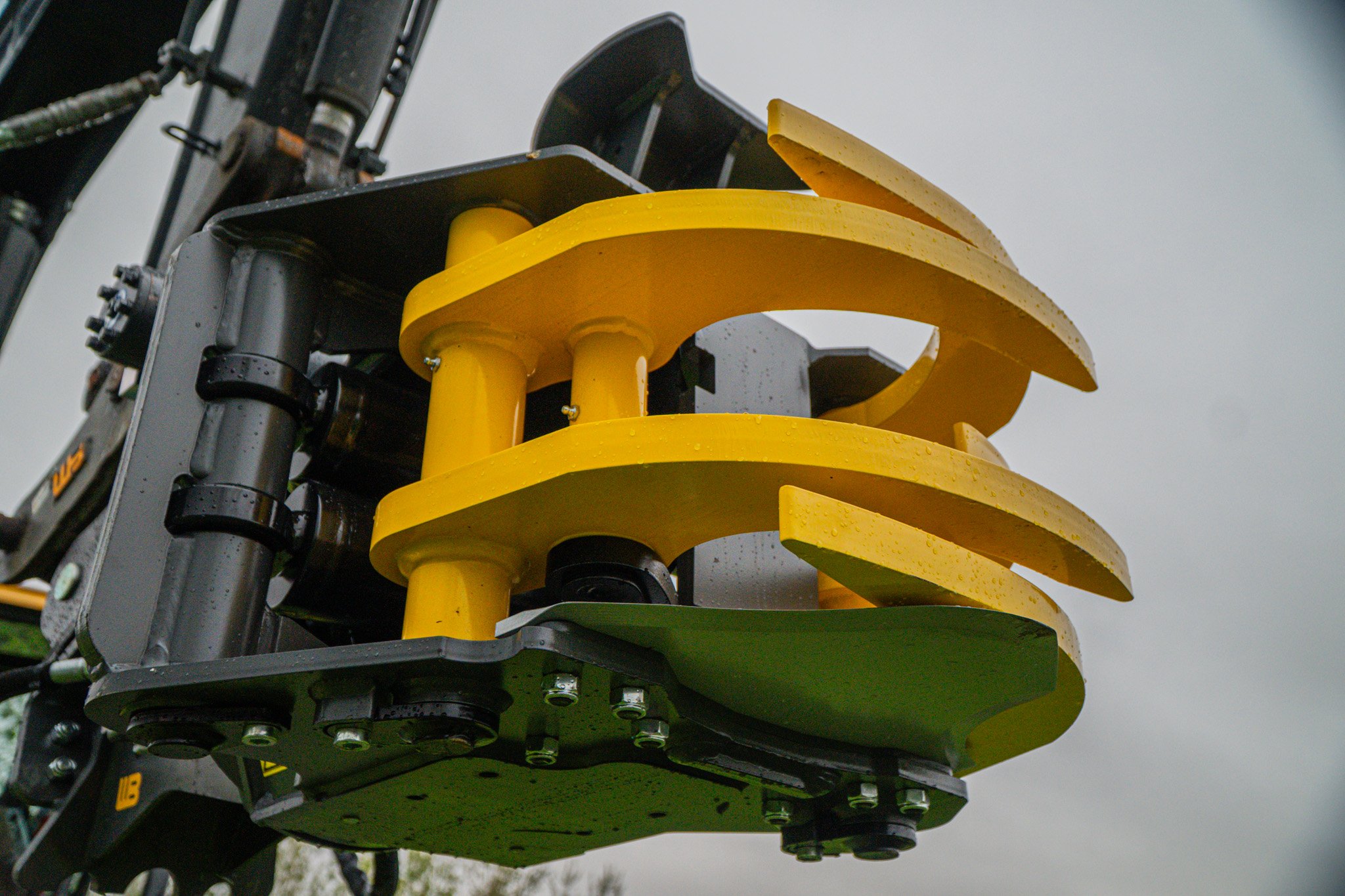
Let’s take a closer look at what makes each machine unique and value to their operators. The number one difference will be the cutting mechanism of each product. A tree shear operates off hydraulic pressure where a grapple brings the object to be cut across a fixed blade cutting through it with force. A feller buncher operates with a high-speed rotating saw blade to slice through the object as it is collected by the accumulator arms to hold it in place. The main difference between the operating systems is that the shear requires the grapple to pull the tree across the cutting blade, giving the operator complete control of the working environment, whereas the feller blade spins into the tree, cutting it before the grapple arms close to complete the cut.
When to Utilize a Tree Shear:
Tree shears are a highly versatile, cost-effective attachment that operates as a 2-in-1 tool with both a shear for cutting and rotating grapple for moving products. These units are great for compact utility such as mini excavators, skid steers and compact wheel loaders, but can also be fitted to larger excavators, telehandlers and wheel loaders.
• Land and Brush Clearing: Shears are best for removing undergrowth, clearing over-grown saplings from fields and fence rows, or for cleaning road right of ways while maintaining control over tight workspaces such as housing developments or utility corridors.
• Small diameter trees: Shears are typically best suited to grasp, cut and move trees up to 16 inches in diameter. There are some heavy-duty units that can handle larger trees.
• Great for wood processing: Grapple shears work extremely well in processing trees for firewood, cutting and loading directly into chippers or for loading into trailers to be removed from the jobsite.
• Budget friendly options: Grapple shears are very cost-effective to buy, lease/rent and maintain than their larger forestry/logging counterparts.
• Small construction and landscaping: Grapple shears are perfect for small construction and landscaping applications where tight, controlled movements are necessary to avoid damage to the surrounding jobsite.
• Versatility of Use Across Operating Systems: Grapple shears are adaptable to multiple machines including skid steers, compact track loaders, mini excavators, telehandlers, large excavators and loaders.
• Disaster Relief: Tree shears are able to quickly cut and clear trees and debris out of roadways.
• Additional Business Vertical: Great for contractors who want to increase utilization of excavators and skid steers that they already own.
When to Utilize a Feller Buncher:
Feller bunchers are very large attachments, designed to harvest large volumes of wood/trees in a short period of time. These units are built exclusively for large forestry and commercial applications. Where grapple shears can be used in very tight and demanding spots, feller bunchers require a great deal of space for movement and are compatible with larger track/wheel loaders and excavators.
• Saw blade built for clean cuts: The rotating circular cutting blade of the feller is designed to limit damage to the tree so that it preserves the value of the timber for market.
• Large diameter logs/trees: Feller bunchers can easily handle trees over 2 feet in diameter in a single pass. The cutting capacity can range based on the types of wood present.
• Commercial timber production: Feller bunchers tend to lend themselves well to the commercial timber industry due to high volume capacity that makes it easier to meet paper mill demands.
• Accumulation of smaller trees/limbs: With the accumulator arms, the feller can be utilized to clear large areas of smaller diameter trees by holding them in the arms before dropping at the end of the cutting cycle.
• Steep or rough terrain: When using a feller attached to a track driven machine, you have better stability on steep slopes or rough terrain, including dense forests.
Direct Comparison
| Feature | Tree Shear | Feller Buncher |
| Cutting | Hydraulic fixed blade | High-speed rotating disc saw |
| Base Machine | Skid steer, excavator, loaders | Large excavator, tracked/wheel loaders |
| Speed & Volume | Efficient, controlled cuts | Fast rotation, large diameter timber |
| Best Application | ROW clearing, landscaping, utility work, disaster relief, land clearing | Commercial logging and timber harvesting |
| Tree Size | Saplings & trees up to 16” | Typically logs 24” and above |
| Replacement Parts | Blade, hydraulic cylinders, seal kits, working jaws, felling support | Disc saw teeth, tooth holders & shanks, bearings, accumulator arms, pins & bushings, cylinders, seal kits |
| Maintenance | Greasing & sharpening blade | Greasing joints, sharpening cutting head, rotating teeth, replacing disc |
| Pricing | $16,500-$30,000 (price includes mount) |
$25,000-$50,000 (and much larger depending on size & configuration) |
| Available Sizes | Skid Steer: 992-2,870 lbs (lift capacity) Excavator: 3-20 MT Loader: 1.3-21 MT |
Skid Steer: 2,200-4000 lbs (lifting capacity) Excavator: 10-35 MT Loader: 7-24 MT |
Lifecycle Cost
Lifecycle cost is where the right choice really depends on the type of work you are doing. A tree shear typically has a lower upfront investment and fewer wear items, which can make it easier to justify for contractors who want to add land clearing, storm cleanup, fence row clearing, or small-to-mid diameter tree removal without buying a dedicated forestry machine. Maintenance is generally focused on the blade, hydraulic components, pins, bushings, and routine greasing, keeping long-term ownership costs more manageable for mixed-use fleets.
A feller buncher, on the other hand, is built for production. The higher purchase price and more specialized maintenance can make sense when the machine is being used consistently in high-volume timber or commercial forestry work. Saw teeth, disc components, bearings, accumulator arms, cylinders, hoses, and other wear items can add to the overall cost of ownership, but the machine’s speed and ability to process larger timber can help offset those costs when production volume is high enough.
In simple terms, the tree shear is often the more flexible and budget-friendly option for crews that need one attachment to handle a variety of clearing jobs. The feller buncher is typically the better fit when the work is more specialized, the material is larger, and the goal is to move a high volume of timber as efficiently as possible.
Functionality
Functionality is one of the biggest differences between a tree shear and a feller buncher. The feller buncher is more specialized, which can be a major advantage when the job is straightforward, repetitive, and focused on cutting and bunching timber at a high production rate. That single-purpose design helps it perform extremely well in the right application, but it can also limit how useful the machine is outside of commercial forestry or high-volume clearing work.
The tree shear offers more versatility. It can cut, grab, rotate, move, sort, and place material, which makes it useful for contractors who work across different job types and need an attachment that can do more than one thing. That versatility is a strong advantage for land clearing, right-of-way work, storm cleanup, and property maintenance, but it may not match the speed or production capacity of a feller buncher when the job calls for continuous harvesting of larger timber.
Bottom Line
Both attachments have a clear place in forestry and land clearing work. A tree shear is a strong option for contractors who need control, versatility, and a more accessible attachment that can work across multiple applications. A feller buncher is built for crews that need speed, volume, and dedicated production in larger timber or commercial harvesting environments.
At Werk-Brau, our team understands that the right forestry attachment depends on more than tree size alone. From carrier fit-up to jobsite demands, production goals, and long-term value, we can help you look at the full picture before making a decision. To talk through the best option for your operation, reach out to our team at 800-537-9561.
Mike Corley is Werk-Brau’s Forestry & Land Clearing Specialist, helping contractors find the right attachment solutions for tree removal, land clearing, right-of-way work, and forestry applications. With a practical understanding of carrier fit-up, jobsite demands, and long-term attachment value, Mike works with customers to match the right equipment to the work they do every day.
Topics:
