
At a glance:
An oversized bucket does not just underperform. It actively works against your machine, drives up operating costs, and creates real safety hazards. Here is exactly what you are signing up for when the bucket is too big for the loader.
Why Bigger Isn't Always Better
We get it. There is something deeply satisfying about looking at a large bucket on a machine and thinking it is the right call. More capacity means fewer passes. Fewer passes means more productivity. More productivity means a better day on the job.
Except that is not quite how it works. Running a bucket that is too large for your wheel loader is one of the most common and costly mistakes we see in the field. At Werk-Brau, we speak with operators and fleet managers every day, and this topic comes up more than almost any other. So let’s dig in.
The bottom line: An oversized bucket does not just underperform. It actively works against your machine, drives up operating costs, and creates real safety hazards. Here is exactly what you are signing up for when the bucket is too big for the loader.
The Problems You Will Run Into
1. You will break your traction and lose the load anyway
A wheel loader moves material by pushing the bucket into a pile and using the machine’s weight and drive force to fill it. Oversize the bucket and you are asking the loader to push more resistance than it can handle. The tires spin, the machine bogs down, and you end up with a half-filled bucket after all that effort. More capacity on paper does not translate to more material moved in practice.
2. You will exceed your rated operating capacity
Every wheel loader has a rated operating capacity (ROC), typically 50% of its tipping load. When a bucket is too large, even a partial fill can push you past that ROC and into a genuinely dangerous range for tip-overs. This is not a paperwork concern. It is a physics concern.
Carrying a load beyond ROC also subjects your front axle, lift arms, and frame to stress loads they were never designed to absorb repeatedly.
It only takes one fast turn, one uneven patch of ground, or one overloaded bucket to put an operator in a dangerous situation. That is why this matters beyond machine specs and repair costs. At the end of the day, everyone wants to send their people home safe, and running the right bucket is part of making sure that happens.
3. Your hydraulics will work harder than they were designed to
Wheel loader hydraulic systems are sized to match the machine’s rated capacity. Push an oversized, overloaded bucket through a full lift cycle and you are running the hydraulic pump near relief pressure constantly. That means heat, accelerated wear, and a significantly shorter service life on pumps, cylinders, and hoses.
Hydraulic repairs are not inexpensive. Neither is the downtime that comes with them.
4. Fuel consumption increases significantly
Straining to move an overloaded bucket means the engine is running at higher load factors for longer periods. Fuel consumption can spike noticeably, sometimes 15 to 25% above what a properly matched bucket would require for the same volume of material moved. Over the course of a season, that is a material cost impact. With fuel prices where they are, just about everyone is feeling the pressure to cut back on fuel use wherever they can. Equipment is no different. When a loader is working harder than it needs to because the bucket is oversized, it burns more fuel doing the same job. At a time when every gallon matters, that extra fuel use can turn into a real cost fast.
5. Tire wear accelerates dramatically
Wheel loader tires are the single most expensive wear item on the machine. Oversized buckets put additional stress on tires through wheel spin during pile entry and overloading during carry. Both conditions consume rubber faster than normal operation. Given that a set of OTR tires can cost $10,000 to $30,000 or more, the cost adds up quickly. Tire wear is a major part of the machine’s overall lifecycle cost, so any small gain in bucket capacity needs to be weighed against the very real expense of replacing tires sooner.
6. Machine stability and operator safety are compromised
Stability margin shrinks when you are carrying loads at or beyond the tipping threshold. Quick steering inputs, uneven terrain, or a sudden stop can shift the center of gravity forward with very little warning. This is especially critical when traveling on grades or dumping into trucks or hoppers at height.
No productivity gain justifies a tip-over risk.
7. You will damage the loader’s frame and linkage over time
Oversized loads introduce potential bending moments and torsional stresses that accumulate as fatigue cracks in the boom arms, Z-bar linkage, and frame weldments. The damage builds gradually and invisibly until a crack propagates far enough to cause a visible structural failure. At that point, you are looking at major structural repairs or significant loss of asset value.
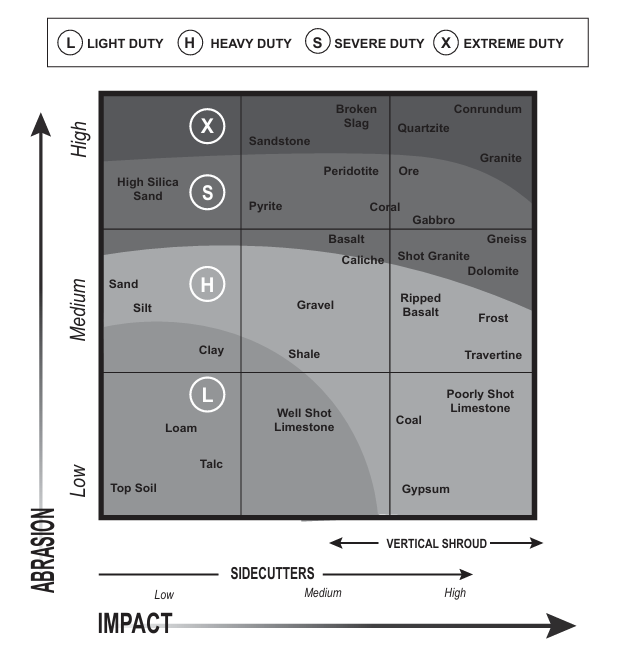
View full bucket selector chart
So What Is the Right Bucket Size?
The right bucket is sized to the machine’s rated payload, the material density you are working with, and the specific application. A general-purpose bucket sized for gravel does not translate directly to working with wet sand or shot rock. The weight per cubic yard changes dramatically across materials, and the bucket selection needs to account for that.
At Werk-Brau, we help you match bucket geometry, capacity, and cutting edge configuration to your actual machine and material. That is where the real productivity gains come from, not from going bigger, but from going right.
Because every loader is different, there is not one universal formula for choosing the right bucket. OEMs calculate tipping load and rated capacity differently from model to model, so we do not guess. Werk-Brau works directly with OEMs and uses their machine-specific guidance to help size the bucket correctly for the loader, the material, and the application. If the answer is not immediately clear, we are transparent about that and work with the OEM to get the right information, so the final recommendation is based on the machine’s real limits, not assumptions.
The goal is always maximum tons moved per hour at minimum cost per ton. A properly matched Werk-Brau bucket, built for your loader and your material, will outperform an oversized bucket on every shift. Reach out to your regional sales account manager and let’s find the right configuration for your operation.
Topics:
