
.jpg?width=4608&height=3072&name=EDR%20Loader%20(3).jpg)
At a glance:
-
Rock, rip rap, and aggregate create heavy wear on bucket cutting edges, floors, and sidewalls.
-
Choose a bucket based on material abrasiveness, impact, and rehandling frequency—not simply the heaviest option available.
- General Purpose buckets work well for occasional rock handling and mixed-material jobs.
- Severe Duty buckets are the best fit for most daily rock, rip rap, and aggregate applications.
- Extreme Duty buckets are designed for high-volume quarry and mining environments where downtime is costly.
- The right bucket can reduce wear, repairs, and downtime while lowering long-term operating costs.
If you’ve ever watched a general-purpose bucket get chewed up in a quarry, you already know the answer to “can I just use what I’ve got?” You can… for a while. Then the cutting edge rounds off, the floor thins out, and you’re buying a new bucket way ahead of schedule. Working with Werk-Brau and a number of dealers across the U.S., I’ve seen too many customers trying to save money up front and regretting it when the bucket ultimately fails prematurely or delays production during repairs. On the flipside, I have also seen end users that wanted a bucket that was unnecessarily heavy for their application, which costs them efficiency, fuel consumption, and unnecessary wear on the machine linkage.
Rock, rip rap, and aggregate are three of the toughest materials a wheel loader bucket will ever face. They’re heavy, they’re abrasive, and they’re unforgiving on anything not built specifically to handle them. So the real question isn’t just “what’s the best bucket”, it’s “what’s the best bucket for my application, my material, and my budget.” That’s what we’ll break down here: a Good, Better, Best comparison so you can match the right bucket to the job instead of guessing.
Why Rock, Rip Rap, and Aggregate Are So Hard on Buckets
Before comparing options, it helps to understand what’s happening to your bucket every time it goes into the pile.
Rock and shot rock are sharp, dense, and irregular. Every pass drags jagged edges across the floor and side plates, and the impact loading on breakout is far higher than in dirt or sand.
Rip rap is large, angular stone used in erosion control and slope stabilization and is often handled in a rehandling application: picked up off a stockpile, loaded into a truck. That means more scraping, more impact, and more stress concentrated at the cutting edge and floor of the bucket.
Aggregate (crushed stone, gravel, sand-gravel mixes) is more abrasive by volume than people expect. Even though individual pieces are smaller, the sheer tonnage moved daily in a quarry or aggregate yard means constant, grinding wear on the bucket floor and wear straps.
All three materials attack a bucket in the same three places: the cutting edge, the floor, and the side plates. That’s exactly where the differences between bucket tiers matter most — and exactly where the wrong bucket costs you the most in downtime and repair.
The Three Questions That Determine Which Bucket You Need
1. How abrasive is the material? Crushed limestone wears differently than granite rip rap.
2. How much impact loading are you dealing with? Digging into a stockpile is gentler than breaking into a shot rock pile.
3. What’s your rehandling frequency? A bucket that’s loading trucks 200 times a day needs more floor protection than one used occasionally.
Good: General Purpose Loader Bucket
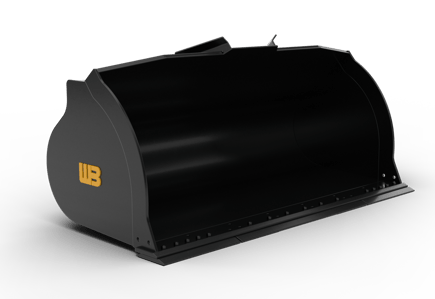
Best for: Lighter-duty digging, occasional rock handling, mixed-material operations where rock isn’t the primary application every day.
The General Purpose bucket is engineered to dig in virgin soil and rehandle material up to 3,200 lbs. per cubic yard in density — which covers a lot of ground, including lighter aggregate work. It features high-strength, abrasion-resistant steel in critical wear areas and solid-welded seams for long-term durability. On larger size classes, standard wear guards help protect the sidewalls from wear while also improving material flow during dumping. An inclined bottom design reduces loading forces while improving material release, and the reinforced bottom structure is built to handle the digging forces of today’s more powerful machines.
Why it’s a solid “Good” option: If rock and aggregate are part of your workload but not the whole job, for example, a contractor who’s mostly moving dirt and occasionally loads gravel, this bucket gives you real durability without paying for wear protection you won’t fully use. It’s the right starting point for versatility.
Where it falls short for heavy rock work: It’s not purpose-built for constant high-abrasion rehandling. If you’re in a quarry environment or running rip rap daily, you’ll outwear this bucket faster than the two options below.
Better: Severe Duty (Straight Lip Rock) Loader Bucket
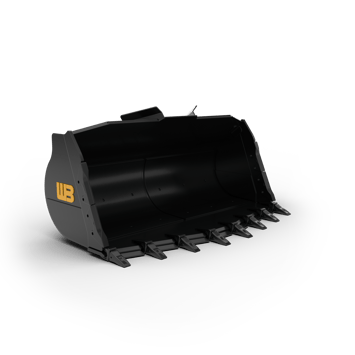
Best for: Quarries, aggregate yards, and construction sites doing regular rock handling, loose rock rehandling, and high-abrasion daily work.
This is where Werk-Brau’s lineup steps up specifically for rock. The Severe Duty Loader Bucket is engineered around high abrasion resistant steel in all critical wear areas, with upgraded wear straps reinforcing the bucket floor. This is the exact spot that takes the brunt of aggregate rehandling. While wear guards are standard only on larger General Purpose bucket sizes, the Severe Duty Rock Bucket includes side wear guards across the entire product line to help reduce sidewall friction and promote cleaner dumping. Weld-on teeth come standard, while bolt-on cutting edges and alternate tooth configurations are available for application-specific needs.
Why it’s the right call for most rock and aggregate operations: This bucket is purpose-built for exactly the scenario in this article’s title; loose rock handling, severe digging, rock rehandling, and high-abrasion quarry environments. For most contractors and aggregate producers, this is the sweet spot: significantly more wear protection than a general-purpose bucket, without moving into the extreme end of the lineup while adding additional unnecessary weight and cost.
One thing to watch: If your material runs on the denser, more abrasive end, like granite, rip rap, shot rock in a hard-rock quarry, or if you’re rehandling constantly at high volume, it’s worth having the conversation about whether the next tier makes more sense for your total cost of ownership.
Best: Extreme Duty Loader Bucket
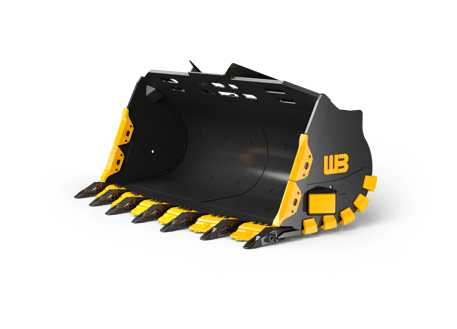
Best for: The harshest rock and aggregate environments; high-density rehandling, virgin soil digging in rock-heavy ground, and quarry or mining operations where downtime is the most expensive line item on the job.
Introduced at ConExpo-Con/Agg 2026, the Extreme Duty Loader Bucket is Werk-Brau’s top-tier answer to the toughest material-handling conditions in the industry. It’s built with high strength abrasive resistant steel including Hardox 450 in high-wear areas, and an extra-thick AR cutting edge backed by a wear plate that runs the entire length of the bucket floor — not just the high-contact zones. Side wear plates add further protection in the areas that see the most abuse, and an inclined bottom reduces loading forces so the bucket performs better and lasts longer under sustained high-density rehandling.
It’s perfect for rehandling of abrasive material up to 3,200 lbs. per cubic yard in density, with capacities from 2 to 9 cubic yards, and standard sizing to fit loaders of all classes. Because it’s engineered in-house with finite element analysis, it holds up in the most strenuous conditions and applications.
Why it earns “Best”: When your bucket is in rock and aggregate all day, every day, the cost of a bucket isn’t just the purchase price — it’s the downtime when a floor wears through or a side plate cracks mid-shift. The Extreme Duty bucket is built specifically to push that failure point further out, which is where the real ROI shows up over a multi-year ownership cycle.
Who doesn’t need this tier: If rock and aggregate are only part of your workload, or your rehandling volume is moderate, the Severe Duty bucket will likely give you excellent performance at a lower upfront cost. The Extreme Duty bucket earns its keep in the highest-volume, highest-abrasion applications.
So Which One Should You Actually Buy?
Match the bucket to your daily reality, not your worst-case scenario.
• If rock is occasional and mixed with other material → General Purpose
• If rock, rip rap, or aggregate is your regular, daily application → Severe Duty
• If you’re running high-volume rehandling in a quarry, mine, or aggregate operation where downtime is the enemy → Extreme Duty
The best way to get this right is to talk through your specific material, tonnage, and machine with someone who can look at the whole picture, density, rehandling frequency, your loader’s class and hydraulics all factor in. Every operation is a little different, and the right bucket is the one sized and specced for what you’re actually doing on the ground, not just the biggest number on the spec sheet.
In my experience, you either pay for the bucket up front, or you pay for it down the line. If you choose the latter, it will likely cost you much more than if you had purchased the correct bucket to fit your application. If you have to fix a bucket, you will likely incur costs such as loss production, downtime, and heavy overtime to fix your bucket. In the case that your bucket completely fails, you will have to purchase a new bucket and wait for it to arrive to resume work.
Have questions about which bucket fits your application? Talk to our team — we’ll walk through your material and machine specs and help you land on the right fit the first time.
